How AI Is Changing Customer Service Jobs and Careers
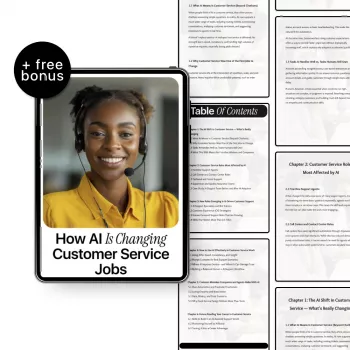
AI is changing how customer service teams handle everyday requests. A chatbot may answer a familiar question, while an agent uses a suggested reply or an automated summary to move a conversation forward. These tools can change the work people do, but they do not eliminate the need for careful judgment or human connection.
If you are considering your next career move, our digital eBook, How AI Is Changing Customer Service Jobs, offers a guide to changing service work, emerging roles, and career strategies. You can start by looking at which tasks AI supports and which skills you want to strengthen.
Where AI Fits Into Customer Service Work
AI tools can help teams respond to common questions, draft messages, and document conversations. For example, a chatbot might provide a standard answer about a return policy, while an agent reviews a suggested response before sending it. Automated summaries can also help an employee understand what happened before a case was transferred.
More complicated situations often call for a person to interpret the details. A customer with an unusual billing problem may need an agent to investigate, explain options, and escalate the case. Empathy matters, too, especially when someone is frustrated or concerned about a sensitive issue.
The effect on jobs varies by employer, technology, and role. Some organizations may redesign workflows or automate tasks, while others may use AI primarily to assist employees. The U.S. Bureau of Labor Statistics occupational outlook for customer service representatives offers additional context on the occupation and its employment outlook.
Customer Service Tasks and the Role of AI
| Task | Potential AI Support | Human Contribution |
|---|---|---|
| Answering common questions | Suggest or deliver standard answers | Check accuracy and address exceptions |
| Handling complex complaints | Summarize the issue | Use judgment, empathy, and escalation |
| Documenting interactions | Draft conversation summaries | Review details and correct errors |
Skills That Matter as Service Roles Change
Clear communication remains valuable whether you write every response yourself or edit a suggested reply. You need to understand the customer’s question, explain the next step, and choose a tone that fits the situation. Problem-solving and emotional intelligence help you recognize when a standard answer is not enough.
Familiarity with AI tools adds another useful layer. Practice reviewing suggested responses for incorrect policy details, missing context, and language that sounds inappropriate. A polished answer can still be wrong, so compare it with approved information before relying on it.
Privacy deserves the same attention. Use only tools approved by your employer, follow policies on customer information, and avoid entering sensitive details where they are not permitted. If a tool produces an uncertain or troubling response, use your team’s process for reporting the issue or escalating the case.
Emerging Roles and Career Paths
As service teams adopt new tools, you may encounter roles that combine customer support experience with quality review, content maintenance, or operations work. Titles and responsibilities differ across organizations, but these directions can help you explore your options:
- AI-assisted support specialist: Helps customers while using approved tools to prepare responses or manage case information.
- Quality analyst: Reviews interactions for accuracy, consistency, and adherence to service standards.
- Knowledge-base specialist: Maintains help content so agents and customers can find reliable answers.
- Support operations professional: Helps improve workflows, reporting, and the tools a service team uses.
Compare several job descriptions before deciding which path fits you. Look for repeated responsibilities and skills rather than relying on a title alone. You may already have relevant experience from resolving difficult cases, spotting recurring issues, or helping colleagues find accurate information.
Turn Career Questions Into a Practical Plan
Start with a short inventory of your strengths. Are you especially good at calming upset customers, finding policy details, or explaining complicated steps? Choose one target role and identify one skill you can develop for it, such as quality review, concise documentation, or working with an approved support tool.
Next, keep a record of examples that demonstrate your work. You might describe a customer problem you resolved, an improvement you suggested, or a time you caught an inaccurate response before it was sent. Follow your employer’s confidentiality rules and leave out identifying customer information.
Review job postings regularly to see how requirements change. You can also ask a manager or mentor about projects that would let you practice a new skill. A small, relevant project can help you decide whether a direction is right for you.
Explore the Digital eBook Guide
Our How AI Is Changing Customer Service Jobs digital eBook guide focuses on AI’s effects on service jobs, emerging roles, and career strategies. It may be useful if you work in customer service, are seeking a job, or are exploring a career change. The digital eBook is listed at $21.99 USD.
For a separate guide to a different kind of interpersonal setting, we also offer the Table Etiquette Checklist. It is not a customer service career guide, but you may find it relevant if you are also interested in everyday etiquette.
FAQ
Will AI replace customer service jobs?
AI can automate some customer service tasks, but its effect on jobs differs by employer and role. Complex or sensitive interactions may still require human judgment and support.
What skills can customer service workers develop for an AI-enabled workplace?
You can strengthen communication, problem-solving, and judgment while learning to use approved AI tools. Practice checking responses for accuracy, appropriate tone, and privacy concerns.
Who is the digital eBook guide for?
The guide is relevant to customer service professionals, job seekers, and people exploring career changes who want to learn about changing roles and career strategies.











Leave a comment